


The current group show in Zurich presents the four artists Karin Kurzmeyer, Sophie Dupont, Sofie Thorsen and Theis Wendt, all of whom deal with "space" in their particular way. They have in common that they explore possibilities to expand their artwork into the third dimension and thus achieve additional consideration within the space. This stunning group show in Zurich will take place from 13 October to 12 November in Zuirch.
SOPHIE DUPONT (DK) | KARIN KURZMEYER (CH) |
SOFIE THORSEN (A) | THEIS WENDT (DK) |
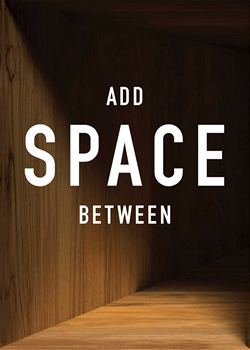
>> ADD SPACE BETWEEN <<
Opening: Wednesday, 12 October 2016 | 6 - 8pm Kreuzstrasse 15, ZURICH, Seefeld Opening times: Wed - Fri 11am - 6.30pm, Sa 10am - 4pm
GALLERY | PETRA GUT CONTEMPORARY ZURICH
The current exhibition presents three female artists and a male artist, all of whom deal with "space" in their particular way. They have in common that they explore possibilities to expand their art work into the third dimension and thus achieve additional consideration within the space.
Sophie Dupont embraces space with her body and performing gestures. Sofie Thorsen's paintings do not end at the edge of the canvas but continue on the wall. Karin Kurzmeyer forces the audience to move around a given path by deliberately placing her sculptures in the art space. Theis Wendt's works are not simply reflections - they appear to turn the space surrounding us inside out.
"We Always Carry Our Body" is the most recent work of the Danish performance artist Sophie Dupont (*1975). In this work, Dupont carries body parts made of brass on a stand above the head. The stand, comparable to a skeleton, holds the hanging parts together like a Mobile/puzzle. Her body is covered by a skin-tight black-pink costume, likewise depicting outlines of her internal organs and body parts.
Thus, the body is exposed twice, even three times; as actual body and as an image of the experience of our body that we create in our mind. The stand on the head appears like a trophy and at the same time like a crucifix that we carry with us throughout our life. The audience is requested to randomly place each individual body part on a canvas on the ground. Once all parts are placed on the canvas, Sophie Dupont frees herself from the scaffold and walks over each individual "body part" lying on the canvas. The scaffold and the two pictures showing the prints of the body parts will remain after the performance as pieces of art.
Performance is only one form of media the former dancer tackles. In addition, Sophie Dupont works with photography and sculptures.
The installations of the artist Sofie Thorsen (*1971), living in Vienna, refer to questions of space, architecture and perception. Usually, her work is guided by a special interest in a certain object or circumstance. Using this as a starting point the artist develops her pictures and installations. At the moment, Thorsen's work focuses on lines, surfaces and the exhibition wall. The fine lines of her pictures are created by oscillating a pigment dusted chalk line.
Other central topics are photography and paper as "sculptural materials". As soon as a sheet paper is elevated, it gains a three-dimensional effect. When cut into a form other than a normal square, it becomes a complex, fragile sculpture. This three-dimensional image and the blurred, intensive pigment lines make up the centre of her work and are testament to the fragile qualities of image and space that surround us.
The artists, Theis Wendt, (*1981) living in Copenhagen, in his artistic activity is concerned with the way modern communication technology changes the representation of images and the human perception of the world. He plays around with surfaces and wants to irritate the viewer.
In the series "Rift" he works with digital prints which at first sight appear like passages through a wall, but at the end of the day are pictures and also presented as such. Wendt's series "Rift" does not show anything unfamiliar, but the familiar and trusted is presented from a completely new perspective. Instead of simply looking out of a window, one simultaneously looks onto reflections of the glass. The latter appear to turn the space surrounding us inside out.
Equally, in the series "Sunk" common perceptions are broken up. This picture series consists of aluminium castings and polystyrene sheets. Polystyrene, the light-weight and insulating material is turned into something cold and heavy. It is no longer hidden as building material. The transformed surfaces reveal their own world of images: For instance, they remind of scarce landscapes - rejecting and foreign and yet attractive.
Karin Kurzmeyer (*1987 in Lucerne) likes the sense of immediacy of clay which she forms into sculptures. "The handling of the clay is like finger exercise," states the artist living in Zurich. "I well and truly knead and massage the material". The sculptures appear grown. Hand and finger marks are visible and turn the brittle material into something sensual. The artist is fascinated by clay as each type of clay possesses specific characteristics and the material is "obstinate". When working the clay, Kurzmeyer transfers her knowledge of the body to the object.
Drying the objects can take up to four months, afterwards they are fired. The clay gains new characteristics through the firing process. Colour and density change. Kurzmeyer uses different types of clay and different firing stages which produce varying shades of colour. The positioning of the large sculptures in the art space is an important part of her work. The objects develop their full creative potential only through the varying perspectives of viewing.